Category — Asia
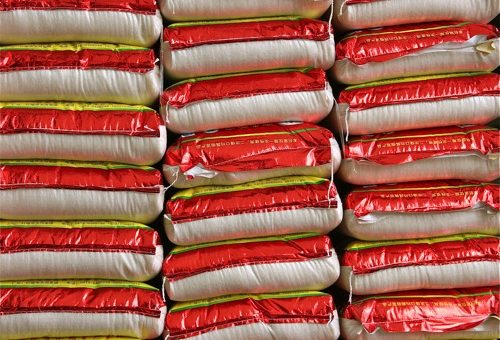
{wordless wednesday} Stacks of Snacks in Chengdu, China

June 17, 2009 4 Comments
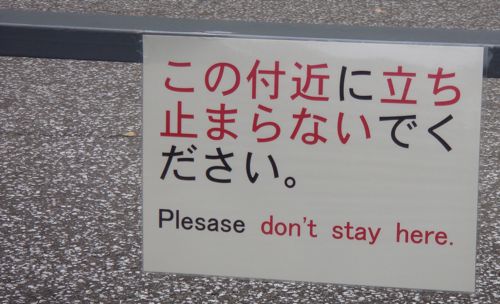
{engrish} Lost In Translation: Signs in China
I saw some really great signage in China that made me laugh and sometimes made me feel perplexed and I liked them all a lot. Here are my favorites!

This is from a menu in Harbin… but how to decide if I should order the “The syrup forks the fever” or the “The gold medal burns the goose?”

The “CrazySelf-Help” Karaoke Bar in Harbin.

Yeah, people should totally be “thinkgking” of that before urinating. This sign was in a (very fancy) mens restroom at Qingcheng Mountain, which is actually the birthplace of the Tao religion so I guess they want to make sure everyone remains all Zen. Er, Tao. (Ross took this picture so don’t blame me if it’s all shaky.)

This ticket sign for a museum in Harbin is not exactly PC: you’ve got your “Old People” price, and your “Deformity People” price, in addition to everyone else.

I can’t help reading the message on this Christmas decoration like a command. “Xmas! Marry!”

The first 2 seem reasonable, but the last one really seems a little lofty for being a random sign in a private KTV (karaoke) room (in Tibet Hotel, Chengdu.) If it helps, the name of the private karaoke room was “Sacred Umbrella.”

These meat cubes roasted on a skewer with Caucasian flavor are looking delicious on this ad for a Russian restaurant in Harbin. Doesn’t mention whether it contains actual Caucasians or not though.
This is one of my most favorite signs. These are the Chengdu Municipal Rules Pertaining to Civilzed Tour which are all over the city, in touristy spots. All of the rules are really applicable to life, but I particularly like:
#1: “Don’t spit.” HA! In China? Yeah right! Everyone is hocking loogies constantly.
#3: “Don’t give animal any food without permit when you are in the zoo.” Is this REALLY a problem?
#5: “Do not be out for small advantages.” No idea what that refers to, I’m guessing euphemism.
#7: “Do not wear clothes exposing the neck or shoulders in public places.” This is China, not Saudi Arabia, so I don’t get that one either- we saw plenty o’ necks and shoulders and no one seemed to mind.
#8: “Advocate a happy and healthy way of life. Resist superstition. Avoid pornography, gambling and drug.” Amen to that. Although realistically, I’m not sure reading it on this sign is going to be the tipping point for people in the clutches of those particular vices.
May 27, 2009 1 Comment
{restaurants} Foraging for Food in Harbin, China
Oddly enough, there are basically no resources I could find on the web or in a book or really ANYWHERE about where and what to eat in Harbin, China. Being home to the fabulous winter wonderland known as the Harbin Snow and Ice World I thought maybe other people had gone there and eaten things and written something about it but it seems that’s actually not the case. And what little is written about it is pretty thin on details AND choices. So, in an effort to provide a helpful, instructive resource for anyone who needs/wants to eat in this frigid burg of 10 million people or so- I offer you what I learned about eating and drinking from my short trip there this month, but I warn you… it ain’t much.
The bulk of the (mostly useless) travel resources on Harbin were wont to describe these frost-covered folks of Northeastern China as gruff, hardy types who drink a lot to stay warm. I don’t know if that’s exactly true, but because of its proximity to Siberia, Harbin is home to many Russians so of course there is a heavy Russian influence on the food. The upshot of this is that there is some good Russian food to be had.


the Russian onion dome of St. Sophia church now houses a museum of Harbin history in its gorgeous interior.
Harbin is not touristy for Westerners, which means 3 things, as far as I can tell. The first thing is that you can eat well really cheaply- more challenging in more well-visited Chinese cities- and have a sit-down dinner for 2, in a perfectly nice restaurant with drinks, for no more than US $10, or even cheaper for lunch or breakfast. The second and most difficult thing (for me, and other non-Chinese speakers I assume) is that there is not much English spoken and there are not always English menus, which can pose challenges. For example, one morning we had no trouble getting big yummy plates of fried dumplings but it took us about 20 minutes of pointing, gesturing, and pantomiming to get a bottle of water. But, food being food, you can generally figure it out! And the third and funniest thing is that when they do have an English menu, often, hilarity ensues from reading the bizarre translations.
There is a long, cobblestone pedestrian street that combines Chinese, Western, and Russian architecture in an attractive way. This pedestrian street, Zhongyang Da Jie, or the Central Street, is home to many restaurants and quite a few bars.

A cheaper, chillier, chancier alternative to taking a taxi home in the cold.
Of course, Harbin is not immune to Western influence- you can get your standard fast food in Harbin, and as in the rest of China, KFC reigns supreme. With over 30 branches in town, they are so ubiquitous that one place we were looking for was described to us as “near the KFC on the main street” and we were vexed not to be able to find it- until it dawned on us that there was, in fact, a KFC on every other block of the main street. You can find McDonalds and Pizza Hut as well. But the only vestige of globalization that you will probably actually desire will not be available, because Harbin remains untouched and unspoilt by all of the good Western coffee chains, including Starbucks. You’ll have to turn to watery hot chocolate, Nescafe, jasmine tea, or whiskey to warm and comfort yourself on the cold winter nights (and mornings and afternoons too.)
But that’s quite enough exposition: Here are my thoughts on some places to eat and drink!
USABucks
How to get there: it’s on Zhongyang Da Jie, about 3 blocks down from the Songhua River end. It has a pretty big sign so it would be hard to miss.

This is a HILARIOUS place. With no Starbucks, you might think of trying USABucks but I recommend you go for an alcoholic drink there, NOT a coffee- the coffee is weaker than a Minnesota bridge and nearly as unpleasant. And while the logo bears a striking resemblance to Starbucks, once inside the place, you’ll see it’s actually done up in Sarsaparilla-style Old West saloon-type deal. But, it has 2 things going for it: it’s really warm inside, and it’s kind of fun. They have snacks too- me personally, I was not adventurous enough to order one of these snacks- here is the menu- a pretty far cry from the scones and muffins you’ll get at the original ‘Bucks.

I know, it’s SO hard to decide whether you want Explode the Valley (?!?!?), Dried Intestines, or Red Bowel with your crappy coffee. But really- go to warm up and order a beer or some whiskey, maybe a Happy Nut to go with it, and enjoy the scene… which may or may not include the owner parading around in full 1920s military regalia, greeting the patrons like a Chinese Eva Peron.
Lao Chang Spring Pancake
How to get there: the address is 180 Zhongyang Da Jie (The Central Street) and it has this nifty sign in English. It’s about 2 blocks down from the Songhua River end of and this is what the sign looks like, for your edification.

This was a great spot! Imagine an order of mu shu pork. Now imagine, like, mu shu everything. That’s pretty much the concept of Lao Chang Spring Pancake. You order a bunch of stuff, and spring pancakes with sauce and onions, and you mu shu all of it up and eat pancakes. It’s really tasty and it’s a pretty nice restaurant- and a nice hearty lunch with entirely too much food, for 2 people, was around US$15 with beer and tea- so I think you could realistically get out of there for much less, if you ordered fewer mu shu-able items. We left more than half of the food uneaten- we just had no idea how big the portions would be or how filling it was.

Orient King of Dumplings
How to get there: I think there is more than one, but the one we went to is a couple of buildings down from the Shangri-La Hotel, so if you are facing the Shangri-La, it’s to your right.

We ate breakfast here because the stupid continental breakfast in the Shangri-La Hotel was 138 yuan per person. That’s like almost US $40 for 2 people which is a crazy price! So we walked on over to Oriental King of Dumplings and got some freshly-made fried dumplings for breakfast each day. You can watch a bunch of folks in surgical masks rolling out and filling the dumplings. They have an English menu… sort of. This is the most bizarre and entertaining bit of the menu:

I totally wanted to order “scalding cymbidium” but Ross wouldn’t let me. What IS that?! And how did they get the word “lobscouse” for soup? (Don’t answer that: according to wikipedia, cymbidium is a kind of orchid and oleaster is a kind of shrub… so those seem odd. It turns out “lobscouse” is an obscure British sailor’s term for a hardtack stew. SO the only logical conclusion I can draw is that the menu translator is actually a myopic, floraphilic, 19th century Liverpudlian stevedore. There is simply no other possible explanation.) We actually did order something from the “Fries explodes” menu one day- mistake- I would stick with the dumplings. At any rate the dumpling section of the menu is translated reasonably – you can get fried or steamed, and for my money the fried are more enjoyable. They’re 3.5 yuan (50 cents) for 6 and each person will probably need around 12. So you can get out of there for a $2 breakfast unless you do as the Chinese do (and apparently, now I do) and drink beer with breakfast, in which case you’ll end up spending a couple more dollars.
Russia Food and Coffee
How to get there: It’s right near the KFC! Just kidding. I mean, it is near a KFC but that’s totally unhelpful in this context. It’s just off Zhongyang Da Jie, essentially across from Lao Chang Spring Pancake- about 2 blocks down from the Songhua River end of the street.

This place is I think the only place I saw in a guidebook- but it makes sense because the food is quite tasty, the service is nice, it’s cheap, it’s a pretty attractive ambiance, and it doesn’t have a funny menu, just a regular menu. We got pot beef which was a deceptively large amount of beef and vegetable stew in a little tiny pot, mashed potatoes with black pepper sauce, and best of all, a fantastic piroshki (they spelled it “piloshki”)- one of my best ever… a good piroshki is hard to find! (The other two that round out my top three are my friend Jane’s homemade ones, and the ones we used to get as kids from a now-defunct Russian shop on 9th and Irving.)

Dinner for 2 was around $10 with beers. They had a lot of fun coffee and tea choices but we were too full. It seemed like it would be a nice place to warm up with a tea and a snack if you’re hanging out on Zhongyang Da Jie during the day!
Mr. Lee California Beef Noodle King U.S.A.
How to get there: they’re a chain so you will see them all over China. The one we went to is near the St. Sophia end of Zhongyang Da Jie (The Central Street.)

I don’t know what is up with this name- I find it pretty amusing- but this is a chain throughout China. We were really hungry and wanted to be warm so we checked it out. For 10 yuan (about US $1.40) you can get a big bowl of passable ramen in beef/soy broth with chunks of beef. The beef is a little like yak meat (ie: chewy as hell) but damn, it’s not too bad, especially if you’re cold and want to be thrifty! I imagine if you were drunk it would also be satisfying. It’s not, like, awesome though.
Ice Palace Bar & Restaurant in the Shangri-La Hotel
How to get there: go to the Shangri-La hotel in the winter and ask where the ice bar is.

The Shangri-La sets up an ice bar- a bar made of ice with ice stools and everything ice- in such a way that you can enter and exit from the warm hotel. There are other ice bars we saw but this one was the coolest because it was the iciest- it had more things made of ice than the other places- and it was kind of hip with good lighting and dance beats. You can also grab a larger table and eat hot pot in this ice bar, which would be an interesting combo of the spicy spicy oil at the icy icy table. If you don’t bring a coat, they’ll lend you one. It was really expensive but I think that’s directly related to the fact that we stupidly ordered really expensive drinks, so I think it would only be kind of be normal hotel expensive if you paid more attention!
Coffee Garden
How to get there: it’s in the Shangri-La hotel.

“Coffee Garden” is a total misnomer because it’s actually a full-service restaurant that’s pretty nice. They have a lot of American/Western food and some kind of somewhat Westernized Chinese options. We only ate here because it was in our hotel and we were too cold to go out, but then it was surprisingly quite good and not nearly as expensive as we expected- reasonable, in fact… which is funny because everything else in the hotel was really expensive. We kept getting French Onion Soup room service and tried some other soups, which were really pretty tasty if you’re in the mood for something Western- but we really didn’t try the other stuff. A meal of hearty soup was around 30 yuan or less, like $4 or $5, which seemed reasonable in this context. Also, you can get imported wine if you have the hankering, but that will set you back a bit more. They also have a big fancy buffet that many people were partaking of- very lavish- but I’m not a buffet type of gal. After a couple weeks in China, sometimes you have the urge to go West. Note: bad ice cream.
DDL Bar and Coffee
How to get there: it’s a few storefronts off Zhongyang Da Jie, just around the corner from USABucks (walk down towards St. Sophia and hang a right.) Look for the “coffee” sign.

We were having some trouble finding an after-dinner spot and then frigid feet and desperation led us to settle in here. It was a nice surprise- a sweet, mellow, well-lit little cafe/bar with nice people and a good vibe. We had yummy lavender tea and beers and listened to the Russian hipsters chat and smoke.
December 19, 2008 No Comments
{ligers} Siberian Tiger Park in Harbin, China
I was never really truly sure that ligers were real- it seemed like the kind of thing that gullible me would believe in and then later learn I had been hoodwinked and feel stupid for believing Napoleon Dynamite and stuff. Well, when I visited a Siberian Tiger preserve and breeding center up in NE China, where they also have lions. And I SAW a supercute and cuddly-looking-but-could-kill-me-instantly liger in the flesh, sleeping in his enclosure!
A liger is conceived when a male lion mates with a female tiger (tigress)- which is kind of weird and pretty uncommon, since in the wild, tigers and lions don’t have overlapping habitats. But if tigers and lions are raised in captivity together, they might get the idea to mate across species. So perhaps more exciting than seeing the liger itself was the chance to see a liger being conceived- as in, a lion in flagrante with a Siberian tiger! And the proof is in the pudding. Kids, avert your eyes. It’s kinda freaky.
Exciting, eh? The Chinese graciously describe this cross-species canoodling as “Affinity between Lion and Tiger.”
Ligers are infertile- like mules- and very difficult to conceive successfully. They estimate that only 0.1% of couplings result in a successful liger birth, and that there are only around 10 ligers in the whole world! Wow. Ligers are actually the largest cats in the world, whereas Siberian tigers are the largest “pure” cats. Ergo, the coupling between an African lion and a Siberian tiger is going to make a really big liger. And FYI, if a male tiger mates with a female lion, it’s called a tigon.
So, to sum up, Napoleon Dynamite pretty much had it right when he said, “It’s pretty much my favorite animal. It’s like a lion and a tiger mixed… bred for its skills in magic. ” I totally agree. Ligers are cool.
Other highlights of the Siberian Tiger preserve: seeing super big tigers super up close… they drive you out to the big open fields where a bunch of tigers live and breed. I will admit I enjoyed the experience with some trepidation, mostly due to the relatively recent Siberian tiger tragedy at the San Francisco Zoo. Ai, Tatiana!
The tigers seem nonplussed by the presence of the ancient converted school bus (that was so clearly about to break down and leave us stranded with no way to defend ourselves against a gang of enormous bloodthirsty wild animals whose incisors are as long as my arm.)

At one point a guy in a caged-in car drove out and started throwing live chickens out of the car. The tigers clearly know what’s up with this chicken-delivery truck. One jumped on top and grabbed the chicken.
This guy got the 2nd chicken. Victory! He is kind of giving me the evil eye, don’t you think?
It’s a little bit sad to see the chickens- probably not realizing their imminent fate is to be tiger food.
There were many many tigers in the center, and some other cats. It seemed a little unfair to the African cats to be living in such a cold environment and the lionesses all had to huddle for warmth!
All around a super fun and interesting event! Unfortunately, it’s unclear what the scientific and environmental quality of the tiger breeding plan is, long-term, for the park. There have been reports that when the park has re-released these tigers into the wild, it has not worked out terribly well. It’s unclear if that’s due to the shrinking natural environment or to an inadequate preparatory experience for the tigers that are in captivity. My guess is a combination of those 2 factors and more. Regardless, it is thrilling to experience these beautiful and powerful creatures at such close range.
For more info on the Harbin Siberian Tiger park, check this link.
November 28, 2008 1 Comment
{street food} Sichuan Street Food in Chengdu, China
Chengdu has the BEST street food in the world. Yep, I said it. I mean, they’re famous for it, so it makes perfect sense. There is so much variety, and there are so many things to look at. When you happen upon a market street, set up with overflowing fruit stalls, butchers hacking away at sides of meat, towers of steamed buns, itty bitty coal grills, noodles, candy, pig snouts, dumplings, rice bowls, rabbit heads, skewers, you name it- well, it just kind of comes alive and fills me with joy and delight.

Even the stuff that doesn’t actually, empirically taste good is still fun. Plus, it’s pretty much no risk from a money standpoint. Most things are 1 or 2 yuan- 10 to 20 cents- so you can feel free to try a whole bunch of things, take a bite, and reject or accept them without feeling too badly about the investment.


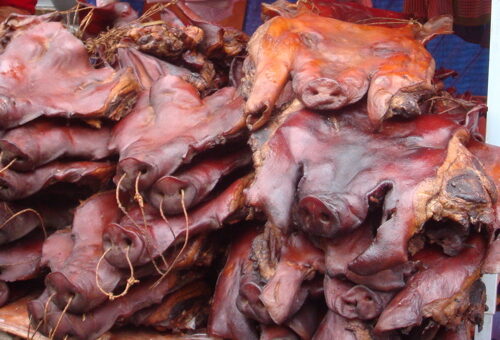
Mmm bacon, it’s smoky, because he’s smoking, ha ha- plus a big ol’ pile of smooshed pig heads- a popular snack.
If you don’t speak Chinese as I don’t, then you will most likely not be able to figure out what is in stuff or what stuff is made of. If you are a vegetarian this might be tricky for you. If not, just go for it with pointing and smiling and taking a bite. It is also extremely helpful to learn the words and hand signals for the numbers 1 through 10 (they have funny hand signals for 6-10) because pretty much nothing will cost more than 10 so you should be ok with just that. Without the numbers and the hand gestures I would have had a great deal more trouble in these many transactions. Here is a helpful tutorial on the number gestures for you.

All the kids on Jinli Road beg for one of these caramelized sugar dragons.

This cat (spotted under the cooking pot on the Tibetan Street) is probably warm, but that’s got to be against the health code, right?
Aside from eating prepared food, or buying raw food to cook at home, there is a plethora of services for you to take advantage of. It’s a full-service deal. For example:
You can get your handbag repaired while-u-wait by someone who uses the most anachronistic sewing contraption I have ever seen!

You can buy a fish and watch her gut it for you on the sidewalk!

Not in the mood for fish? Grab a live chicken off the hook and he’ll hack it up on a wooden block for you with a cleaver!

You can get your knives sharpened too- he carries all the equipment on his bike!

There are many areas where you can find great street food scenes- the ones we had the most fun at were:
- Wadancang Street right near the Tibet Hotel, (which by the way was a fantastic bargain hotel, very fancy for the price and with a lot of fun stuff in the hotel, including a bowling alley! Woo hoo!) So if you are facing the Tibet Hotel, go to your right, and Wadancang Street will be off to your left in about a block. Its proximity is also a big plus of staying at that hotel.
- The area near the Wenshu Monastery had a lot going on, especially candy and sweets vendors- but we weren’t sure if it was a festival type thing or a permanent thing, because it sort of seemed like a festival type thing.
- Sichuan University Area, near the intersection of KeHua Jie and Guo Jia Qiao Bei Jie. The good stuff is on Guo Jia Qiao Bei Jie. Pick up a rabbit head here, if you’re interested, because it seems to be the nexus of that well-loved snack, and they were harder to find in other areas. Don’t worry, there’s a stall with pictures of little bunny heads on it to guide you. Go for the cheeks. Mmmm.
- Jinli Road has a kind of sanitized set of tourist-friendly stalls, with English translations of what they’re selling, but we didn’t eat anything there, it didn’t seem as fun. A better option would be…
- Shuhan Dongjie, near Jinli Road and the Tibetan Street (Wuhouci Cross St.) If you are at Jinli Road gate, and facing out towards Wuhouci Street, the Wuhouci Cross St. is just across the street and forking to the right. Walk down Wuhouci Cross Street for a few blocks, and make a right on Shuhan Dongjie. The street is good in and of itself, but there is also a covered marketplace with old folks playing intense mah-jongg, and some impressive spice and meat products for sale.


The mah-jongg tables at the indoor market on Shuhan Dongjie are plentiful, and deadly serious. But it beats playing poker behind this raw meat and sausage curtain, I guess…
Sharing every food we sampled would be too exhaustive, since we tried like 5 or 10 things a day, but here are some highlights…
Skewers and beer on the street at 11 PM

This was one of our best and most fun meals- a full dinner for 15 yuan including 2 huge Tsing Taos. So, about 2 bucks US for dinner. A lot of times street food is kind of gross-seeming, but this guy had a mobile cart with a coal grill and some of the cleanest looking food I have ever seen. He’s got a bunch of raw skewers, of meat, seafood, and vegetables, lined up like a total Type-A, anal retentive clean freak. He gives you a little tray to fill with raw stuff and then when it’s your turn (there could be a couple people ahead of you, and the grill is pretty tiny) he’ll smack it on the grill and brush it, squirt it, shake stuff on it, until it’s perfectly cooked and super spicy. We had little pieces of beef, chicken on the bone, beans, cauliflower, thin potatoes, and some other stuff. The best were the thinly sliced potatoes (he had them skewered up, but raw in cold water so they wouldn’t get brown) because they tasted like the best spicy potato chip you ever had.
The food was really spicy with lots of numbing spice. Best part: deliciousness of eating experience? Yeah. 2nd best part: Food was US$1.10. 2 giant beers were US$1. So dinner for 2 people, including giant beers, was $2.10 To clarify, GOOD dinner, including 2 GOOD giant beers (Tsing Tao), was $2. You have to get the beers at the little shop across the street. They are 3.5 yuan (50 cents) each. Also, there is a crazy “seating area” comprised of children’s stools and tiny short tables, with toilet paper for napkins. Important note, this guy was at Wadancang Street, and is only there late night though, when most of the other vendors have gone home- seems to be a stop for late night partiers coming home tipsy and hungry. You can definitely get the skewer action from others during the day, but it’s not the same setup with the stools and the old guys playing poker and all so it’s not quite as exciting.
Haw Flakes

Haw flakes are a candy of my childhood, probably because I went to school in SF in a Chinese neighborhood with lots of Chinese kids and Chinese-owned stores. Most (non-Chinese) people I know have never heard of them. My sister and I LOVED them as kids and still do. But in Chengdu, they make them fresh, not packaged, and they taste even better. The other candies we tried- not so much. The haw flakes are the pink discs in the front right of the photo. A big handful was a couple yuan. They didn’t last long! I wished my sister was there to eat them with me. The candy vendors have gorgeous arrays, even if not all of their offerings are delicious to my palate.
Steamed Cabbage Bun

I know, cabbage dumpling does not sound so exciting, but we tried a bunch of kinds and it was the clear standout. The cabbage was very fresh and tasted sort of flash-cooked and then stuffed in the center of a soft doughy bun that comes out of these giant stacked steamers. If I remember correctly this was essentially free. Like, I think we got 6 or 8 buns for 2 yuan which is like 25 cents or so. We tried a bunch, so of course, some were gross. Actually the worst ones were the ones with NO filling. The cabbage ones usually have a little green thing on top, since you’ll have to point. BUT sometimes you can get tricked- we got one that had a green thing on top and then inside there were mushrooms. The ones with a red thing on top have pork that’s pretty good if you like sweet, star anise-flavored pork. The twisty ones that look cool have nothing inside so don’t be tempted just because they’re the prettiest, unless you are planning to get a smoked duck tongue or pig snout from the guy across the street to wrap up in your plain dumpling.
“American Corn”

We had this in a restaurant but were told it’s really a street food. As far as I can tell they make it by taking a can of corn (“American” corn, so they say- they give us no credit for the whole maize thing!) that is kind of fried and then tossed with big granules of sugar. It’s like an unholy union between a piece of kettle corn and a corn nut. And it’s hella good.
Fruit
Yeah, and I don’t even like fruit that much. But how can you not love and support the type of ad hoc marketplace that offers you lettuce from a Vespa, or grapefruits from a bicycle? The bounty that can be found on people’s bicycles or vespas (or batterycycles or horse carts or whatever) is staggering.


Also, the fruit is really fresh and counteracts all of the greasy stuff you are otherwise eating, and plus there are fruits that I have never even seen before which are fun to try. And so very many delicious and affordable lychees and longans for the taking and the snacking.

Plus it’s fun because when you buy something, they whip out this antique abacus-lookin’ gizmo to weigh it.
Waffle Cone

These guys are just like a waffle cone but thinner. When they’re warm, they’re a good crunchy semi-sweet treat. The going rate is 1 yuan for 2, I believe.
Scallion bread or pancake

I ate a bunch of these and sometimes they were really good and sometimes they were too greasy or didn’t have enough salt. When it’s good, it’s like a salty piece of pizza dough with a lot of scallions baked into it. Some of them are so thin they are almost like a crepe, and I didn’t have the best luck with that type. The best one was this one, which I got on Shuhan Dongjie and cost 1 yuan.
-> For Chengdu eats you can enjoy while sitting down, check out this post.
February 23, 2008 1 Comment
{restaurants} Chengdu, China is for Lovers… of Food
I am kind of shocked that no person/guidebook/blog/website happened to mention that the city of Chengdu is heaven for people who love food. Somehow after having tons of great guidebooks and local advice in Beijing, we arrived here in Chengdu with nary a useful piece of information, as our guidebook turned out to be all useless and stuff, so we left it on the plane. But with our sharp wits and a couple Chowhound tips, we have really come to love this tiny Chinese burg of only 10 million people. (It literally seems provincial compared to Beijing.)
Sichuan province, of which Chengdu is the capital, is known throughout the land for having a) great food, b) spicy food, and c) street food. We have had the opportunity to partake in many combinations of a, b, and c. Since the street food is just too much to put in this post I will cover that in Part 2. This will just cover sit-down experiences. Admittedly most of the Sichuan food we ate was from street vendors and little teeny shops so most of these restaurant recs are not strictly Sichuanese or even Chinese, but I think it’s a good rounding out since you can’t eat Chinese food morning, noon, and night. I mean, you CAN, but with all of the options available, why would you?
How to get there: this is not a well-known restaurant, so you basically have to get a cab to take you to KeHua Jie and Guo Jia Qiao Bei Jie, except on a map it looks like these 2 streets don’t intersect. They do, though, so it’s kind of tricky. We had to have someone in our hotel kind of point close to the spot where they almost intersect and tell a cab driver to take us there, then wander until we found it. I included a photo of the outside to help you recognize it, since the sign is not in English or Pinyin.
This is a Xinjiang (Uighur) restaurant that someone recommended on Chowhound. And a terrific recommendation it was! There are a lot of Tibetans, and a fair number of Uighurs in Sichuan province, making your Chinese ethnic food choices all the more exciting. This place is right near Sichuan University so it’s a fun area as well. Outside the restaurant, there is a grill with skewers and round, flat bread- like naan but thicker- which tastes delicious when hot from the oven. We could have, and probably should have just eaten skewers and bread, which were very cheap and tasty. But we were too tempted and ordered the Da Pan Ji, which is a big sloppy pan of chicken, onions, and peppers in a red sauce that sloshes over the side and onto the table. The gorgeous, no-nonsense Uighur waitress came back to the table after a few moments, and in an extremely unceremonious fashion, she dumped a plate of homemade wide flat noodles on top of the chicken plate. All of this was way too much food, but still only set us back around $US 8 including tea and beers- and could have easily fed 4 or 5 people. The setting is extremely bare bones, and on a warmer day the front of the restaurant is open to the street. There is a pinyin menu but no English menu, and the folks there don’t speak English- which is another good reason to just get the lamb skewers and bread from the grill outside, since pointing is effective- although if you say “Da Pan Ji” enough times, they will figure it out eventually.


Dumplings at a little teeny tiny place on Shuhan Dongjie, near the Tibetan Street
How to get there: The Tibetan Street, which is Wuhouci Cross Street, is right near Jinli Road and the Wuhou Temple. So if you are at the Wuhou Temple/Jinli Road gate, and facing out towards Wuhouci Street, the Tibetan Street is just across the street and forking to the right. Walk down Wuhouci Cross Street for a few blocks, and make a right on Shuhan Dongjie. You will pass a covered alleyway market and some other small shops but this is the only dumpling shop on the block, and since folks are making dumplings right there it is easy to spot.
This was a really fun and yummy experience. We saw a little tiny shop where there were 3 people around a tiny table making homemade dumplings. One guy was rolling out the dough, and the other 2 people were filling the skins with all different meats from a bunch of bowls on a shelf above them. There were only 2 tight tables. We pointed and gestured and they made our dumplings right there, then took them to the back to boil them. No English was spoken, so we inadvertently ordered 5 orders of chicken dumplings, instead of ordering 5 dumplings as a snack, but in hindsight it makes perfect sense because it’s not normal to just get 5 dumplings in China, it’s normal to get a whole big plate. So we ended up with a too-big pile of dumplings, probably 30 or so, as it seems 6 is a common number for 1 order of dumplings. They were fresh and tasty, and at any rate they were only 10 yuan or about US$1.50 for the whole plate. But, they didn’t have drinks, so I recommend buying a water or soda or beer at another store nearby before sitting down, or while waiting for your order.

Everything at Tandoor Indian Restaurant
How to get there: it’s right by the Sunjoy Inn, so you can get a taxi to the Sunjoy Inn and it’s just behind it, to the left, kind of in the parking lot.
I know, you’re like, Indian food in CHINA?!?! WTH?? We had to eat here twice because it was so good and because we eventually tired of hot, spicy, numbing, oily Sichuan food and wanted to go for hot, spicy, less numbing, less oily Indian food instead. Even in a city this large, we were assured this was the only Indian restaurant in Chengdu that is run and staffed by Indians. I was expecting it to be not as good as the Indian food I’m used to in SF, but I was happily disabused of that worry when the first dishes came out. The manager spoke with us for quite some time about his own experiences with working and living in China, and how they have had to adapt some menu items for a Chinese palate. Mostly what this means is that there is BEEF and PORK on the menu! Which is so weird! He said that if there is no beef or pork, the Chinese customers won’t come, so they had to put their religious views aside and stick a tandoori pork (amazing) and a beef korma (saucy delicious) on the menu. The naan is freshly made and everything was top notch. The space is quite airy and attractive, with carved wood ceilings and art imported from India. Plus, you get to eat with a fork instead of chopsticks! And they give you a napkin! Dinner for 2 with a lot of food and side dishes was around US $45.

Chilean Wine at the Bookworm
How to get there: it’s right near the Sunjoy Inn and across the street from Tandoor restaurant. You can get a taxi to the Sunjoy Inn, then, if you’re facing the inn, it’s just to your left.
Oh, wine, how I missed you. It’s really hard to get wine in China that’s not massively expensive, or yucky, or both. So to get a big glass of Chilean red for 30 yuan (around US $4.50), in a fabulous setting no less, was a real treat. The Bookworm is a bookstore/cafe/bar and has books in English for sale in case you’ve run out of reading material- at reasonable prices no less- and also they have a library of books you can read while you’re there (and I believe, borrow, if you’re there for a longer period.) It’s cozy and cute and when we happened upon it, there was a swinging jazz quartet playing. The crowd was a mix of ex-pats and groups of young Chinese hipsters. They appeared to offer some food there, like simple pizzas, but we didn’t try it.


The live jazz music at The Bookworm is a welcome auditory shift from people yelling into their cellphones!
HotPot at any restaurant, anytime
How to get there: ask anyone where there is a good hotpot restaurant, they are all over the place and they all kind of seem the same although I am sure many people would find that comment offensive or untruthful in some way.
I feel I have to talk about hotpot because it is a very famous regional thing to eat, and everyone will recommend you eat it. I mean, EVERYONE. But, I don’t really like it that much. The basic concept is that you get a big hot pot of boiling oil over a flame on your table, and you cook meats and vegetables in the oil and then eat them. You can either get spicy oil or a non-spicy oil called Mandarin Duck Sauce, or a half-and-half hotpot that has both. Although it sounds like it will be like a yummy meat fondue, there are several reasons why it is not delicious. The spicy oil is insanely spicy, and even tough spice guys who shall remain nameless were unable to stomach the hot oil, so we were left with the Mandarin Duck Sauce. The “Sauce” was really just oil that was flavored with all manner of odd things, which was only revealed beneath its murky surface when I had the misfortune of dropping a potato into the depths and fishing it out. Fished indeed, as I got more than I bargained for, when the spoon dredged up all manner of fish bones and heads, and slices of organ meats. That aside, it’s also incredibly oily. You cook the meats or vegetables in the hot oil, then you are supposed to put it in a dish of sesame oil to cool it. So it’s like, double-oiled. Even without the sesame oil part it comes out really oily. Also, ironically many people expressed wonder at our desire to eat “unsanitary” street foods, but the hotpot seemed far more unsanitary as it was unclear how many times they reused the oil… and it definitely didn’t seem like they would only use it once. Most Chinese people we asked also felt skeptical about this issue and felt it was most likely being reused. I could handle the grease and the unsanitary aspect if it was delicious. But it just, ISN’T, in my opinion. With so many fabulous things to eat in Chengdu, it is mind-boggling that they keep pushing the hotpot experience on you, since it is the least appealing option. I can’t remember how much it cost, but I think around US$15 or $20 for 2 people.

Small Fries at McDonalds in People’s Square
How to get there: It should be pretty obvious as People’s Square (aka Renmin Square) is the main central plaza in Chengdu and there is a ginormous statue of Mao in it, also the Sichuan Science and Technology Museum (which looks exactly like a giant high school.) Look for ostentatious fountain displays and swirling golden light fixtures.
After a week in China you start to long for things you never even eat in the US. And additionally, eating my golden sticks of American capitalism while looking out the window at an enormous statue of Mao in the main town square is extra satisfying because it’s akin to flipping the Supreme Leader the bird. Dipping each fry in ketchup, then savoring the tasty salty freedom fry in my mouth, I looked at him and thought: You may have killed 50+ million people with your crazy ideas, but in the end, we won! Take that! Price for small fries: 5 yuan, around 75 cents US.

A closeup of the statue of Mao, that can only faintly seen in the photo below
Tea-house Starbucks in Jinli Road
How to get there: get to the Jinli Road gate- there is only one, as Jinli Road is a dead-end pedestrian street- and it’s one of the first shops on the left.
You don’t have to get anything at this Starbucks, although you might be tempted after weeks of Nescafe- but you should pop into this one as it is really very cool! I am a big fan of combining old and new and this place does it quite well. It is in an old wooden carved teahouse building and has been outfitted in a traditional teahouse manner while still being outfitted as, you know, Starbucks. It even has the spacious back garden area like the teahouses. Next door there is a teahouse similarly outfitted if you want to go for the real Chengdu tea experience. Unfortunately I didn’t get a good photo of it so you will just have to go there and see for yourself.
CLICK HERE for CHENGDU STREET FOOD!
February 19, 2008 1 Comment
{restaurants} An Extremely Quick and Incomplete Guide To Eating in Beijing, China
An alternate, and probably more accurate title for this blog post might be “let me write down some good things I ate and drank in Beijing before I forget where they are or what they are called or how much they cost.” But hey, with 20 million people and a sprawl that’s not to be believed, maybe this will help you navigate the massive metropolis a teeny tiny bit. We ate a lot of things, and these were the definite standouts.
DELICIOUS THINGS IN BEIJING
#701 at S Silk Road, on Lotus Lane in Houhai
How to get there: get a subway or taxi to the gateway to the Houhai Lakes area. Walk through the pedestrian gate and veer left. It’s about halfway down and it’s all glass and stuff. The exact address is 51-8 Di’anmen Xidajie, and the phone number is 86-10-6615-5515.
So this is primarily a restaurant with Yunnan food, from SW China. It seems like it’s going to be a tourist trap but then it’s not, also it was recommended to us by Chinese people who go there. It’s all glassy and modern with a weirdly rendered waterfall that flows under the glass stairs, which I think is supposed to look classy but it’s kind of odd. The menu is huge, and funny. Like, they have wikipedia on their menu. Somehow they translated a type of mushroom into the word “wikipedia” and it’s all over the place. Anyway the best thing was #701 which was something like beef braised in pu’er tea leaves and it was super tasty beef in a rich sauce that was so good I dipped my rice bowl into it to get sauce on it and made a huge mess and embarrassed myself, I’m sure. Lunch for 2 people was around US$25.


Lamb “pancake” at Made In China, in the Grand Hyatt Beijing
How to get there: tell the taxi “GRAND HYATT”
One day we went all fancy shmancy and ate at a restaurant in the Grand Hyatt. I had read that the chef was a native Beijinger and an up-and-coming young guy on the culinary scene, so I wanted to check it out. Also, the kitchen is totally incorporated into the restaurant, surrounded by glass, so you can see everything that’s going on. We sat at a counter in front of a glass wall and got to watch a guy preparing the homemade dumplings and potstickers. The overall design of the restaurant was fun and fabulous as well. All of the food we had there was pretty fabulous but the standout was this thing they called a pancake which was really like 2 thin discs of fried dough that sandwiched a spicy, sort of curried Middle-Eastern-tasting mixture of ground lamb. I felt like I could have eaten about a hundred of them, given enough time. The restaurant was insanely expensive by Chinese standards, as we ended up dropping around US$100 on lunch for 2 people. Still, if you don’t want to spend the big bucks then just go, drink water, and eat some pancakes at the very least.

Hot Chocolate at Panjiayuan Market
How to get there: tell the taxi “Panjiayuan” pronounced “pahn-jaw-yoo-AHN” but where you say all the syllables together fast and kind of loud and with a lot of false confidence
I don’t think it’s just because it was 17 degrees and windy that day at the market, the hot chocolate from the vendor guy was damn good. He made it in a fancy Italian-looking espresso machine and it was chocolatey and foamy like a latte. It was surprisingly very expensive for China, like US$4 for a cup. I failed to take a photo of the momentous occasion but you probably know what hot chocolate in a paper cup looks like.
Pizza and Beer at The Tree, in Sanlitun area
How to get there: get to the Sanlitun bar street area, and ask people. The address is technically 43 Bei San Li Tun but be careful because all the streets in that area are like, something+San Li Tun. If you see Poachers, it’s kind of like behind that, around the corner to the left.
They call it The Secret Tree with good reason. It’s crazy hard to find. We were lucky enough to stumble upon their sister restaurant, called Nearby The Tree, and when we asked where the Tree was, a guy working there actually put on his coat and led us through the maze of hutong alleyways to show us where it was. So they say the pizza is the best in Beijing, which isn’t saying much- it’s not great, but it’s fine and a nice respite from, you know, Chinese food. More exciting is the extensive Belgian beer list, so welcome in the land of watery Yanjing beer and essentially no wine or liquor (unless you want to break the bank) and the warm and cozy nature of the place itself, with its mix of Chinese hipsters, families, and ex-pats of all ages. Pizza and a bunch of Belgian draft beers was around US$30 for 2 people.

The very secret entrance to the elusive Secret Tree.
Peking/Beijing Duck at a Chinese place that translates to “Daily Food and Beijing Duck Restaurant”, address unknown and stuff only in Chinese symbols, in the CBD
How to get there: ask a bilingual person to look it up for you and write down the address in Chinese so you can give it to a taxi driver.
I know, lame details on this one but our Chinese friends took us here so what can I tell you. If you can figure out how to find it, though, the menu has pictures so you can just point to the waiter what you want. The portions are huge and the Beijing duck was fabulous. As well, there was fish poached in oil and Sichuan peppercorn, which has the effect of numbing your mouth as if you swished with Vicks Vaporub. The place was hopping, a big, noisy, brightly lit room full of Chinese families celebrating New Years Eve, and our hosts said it was because it serves very good quality food at low prices. Dinner for 5 which was really like dinner for 10 because we took MORE than half the food home, plus a bunch of beers, was only around US$30. Also, remember that in Beijing they have never called it Peking Duck because they have never called Beijing Peking, only Westerners called it that. So they call it Beijing Duck, not Peking Duck.

Whiskey at the Owl Bar
How to get there: it’s in the hutong area so kind of confusing but if you follow these simple directions it should work. If you are standing in front of the Drum and Bell Towers facing them, with the Drum in front, and the Bell behind it, enter the area and pass both towers so that you are to the right of the towers. Where the street ends after the Bell tower, turn right onto Doufuchi Hutong (no sign though, I think), take your second left, then your second right, and you will hit it shortly. It’s on the corner. These are like little alleyways so it’s not that far.
This was a day that was so fun, but so cold, that we actually got the bright idea to stop in this random bar and take a shot of whiskey. Seriously. At like 3 PM. Then, as sometimes random places are, the place was amazing. On a corner in a tiny 800-year-old Beijing neighborhood, you walk into a bar where a guy is playing Resident Evil on his Wii and there are Bing Crosby Christmas carols on the soundtrack. He clearly loves America and he is eager, and kind, although his English is poor. You are alone drinking your giant shot of whiskey (about a double shot of Johnnie Walker Black Label, US$4.50) and as you leave, happy to have warmed up your insides and your outsides, he thrusts a box of markers at you. He wants you to write a message, as countless others have adorned his walls with messages and pictures in every language. Fabulous.


“Rural food” lunch at a tiny hut near the Great Wall
How to get there: befriend native Beijingers, spend time building a relationship and hosting them in your own city, and then one day visit them and ask them if something of this nature is possible, and hope that they are willing to try and make it happen for you.
Again, our Chinese friends took us to this place. If you can call it a place. I’m actually not telling you about this to be helpful, just to share an incredible food and culture experience with you. Basically we wanted to go to the Great Wall and they didn’t want us to subject us to the touristy pieces of the wall that are open to everyone, so they took us to a little tiny town that was buffeted on each side by the Great Wall. We climbed a little dirt trail and our friends chatted with a woman in a shack, asking her if it was OK to enter this part of the Wall, since the families that live here are meant to act as guardians of this section of the wall. She agreed and apparently our hosts also arranged for her to cook for us when we were done hiking. After an incredibly serene and moving 3 hour hike up and down a long section of the Great Wall of China, completely alone but for the 5 in our little group, we were tired and freezing as the weather was around 5 or 10 degrees with galeforce winds the whole time. Now let me tell you, when they told us we would have “rural food” my expectations were not high. I thought, OK, this will probably be pretty gross and served in a cold place. But upon entering the shack post-hike, everyone took off their shoes and stripped off heavy coats, hats, scarves, and gloves and sat on a large kang, which took up at least half of the room. A kang is actually a sort of old-fashioned big flat stone bed that is heated from below with a fire, so it’s warm and toasty to sit on it. After drinking some tea and relaxing a bit, copious amounts of delicious farm-fresh food started appearing. We had been warned that this was peasant food, but if that’s peasant food then I’ll gladly become a peasant. OK maybe not because the “bathroom” was a freezing cold brick shack with no walls with a hole in the ground but still the food was ridiculously good. Fresh whole chicken with Sichuan peppercorn and star anise, plump rice with eggs, battered pepper leaves, and best of all green beans with tiny pieces of pork sausage, ginger, and garlic. I’m dreaming of it right now! My only sadness was that my Dad wasn’t there with me as he would have certainly loved to experience that particular dish, as it was similar to his favorite Hunan dish, which is spicy beans with ham. Lunch for 5 was around US$20. Leaving us plenty of extra dough to sneak in a Chinese foot massage (around US$4.50) before dinner!


All of the food and kang magic happened in that little tiny hut. And just to give you an idea of the view from aforementioned hut…shaZAAM!

Hooters, just kidding, of course we did not eat there, but can you believe they have Hooters in Beijing?!?!?!

January 19, 2008 No Comments
{travel} Harbin Snow and Ice World! Part Two: The Ice
Now we get to THE ICE PART! Which is arguably the more fascinating part. If you haven’t read Part One: The Snow I strongly recommend doing that now, in advance of delving into The Ice, since it contains useful information and background about the event and location as a whole, as well as a good deal of descriptive prose about the extent of the freezingness, iciness, snowiness, coldness, windiness, and so forth. So just to review, we’re in Northeastern China and it’s insanely cold and you have to dress yourself in so many layers that you can’t move or have any part of your face or body exposed and you can’t last that long outside but there’s a wicked cool ice and snow festival and it makes it all worthwhile.
Moving on… without further ado: THE ICE!

So, in case you’re wondering, let’s clear this up: pretty much everything is made of ice, with lights inside. The pathways, the buildings, the stairs, everything: all ice. I love the pathway, it is so fun to walk on, and reminiscent of the Saturday Night Fever dance floor in fact. But more slippery. You can get a sleigh ride along the path!

The Ice World is super cool because it happens at night… when all the coolest things happen, natch. Of course, it gets dark at like 3:30 PM up in Harbin so “night” is sort of a relative term. (Of course, being at night, it’s pretty challenging to take great photos.) If you look up close, the buildings are made of ice bricks, some of which have channels to hold the light tubes, which taken as a gestalt illuminate the whole building. Here’s a close-up of the light in the ice bricks.

The Ice World doesn’t hold much allure during the day- the ice all looks greenish-gray and dingy in the glaring winter sun. But as the sun starts to set, around 3:30 PM, the lights come on bit by bit and the Ice World becomes gradually illuminated from inside out. It is an amazing sight to behold, and one of the most incredible things I have ever seen. It is at its most breathtaking just at dusk, before the sky is completely dark. This only lasts a few moments so you have to be quick to get a photo!

The theme for the Ice World in 2008, which is when these pictures were taken,was, of course, The Olympics. You should realize that 1 billion plus Chinese citizens were collectively in a state of practically peeing their pants about the impending 2008 Summer Games in Beijing. They were, as a nation, proud and excited as hell. (Of course, as individuals, their Olympic fever ranged from raging hallucination-inducing temps to stone cold.) So there could really not possibly be ANY other theme for this Ice Festival. Ergo, you’ve got your ice Olympic rings with the giant “Olympic Tower” behind. You can see little tiny people in front of Olympic Tower- the thing is maybe 8 stories tall? Taller?

They weren’t completely faithful to the theme, but instead presented a seemingly random amalgam of representative buildings from cities to hold past and future Olympics. For example, the dusk picture up top shows a Moscow building (1984 Olympics) and there was a funny London Bridge (2012 Olympics.) They also had the Athenian Acropolis (2004 Olympics):

We couldn’t figure out what the pink church (top picture) was representing. But there were also a lot of pagodas. Pink round ones… I think these are for Beijing?

And red square ones. For Tokyo 1964 perhaps?

But the best thing about the Ice World is that there are so many weird and fun activities. For example…
- You can go on a terrifying death-defying insanely fun and scary ice luge. See the Ice-cropolis? That’s the launch point. The whole curving yellow turreted path is actually the 2 parallel ice luges. It is really long and although it doesn’t look steep, it is. You can see a person in the foreground which gives you an idea of the scale.


- You can climb these ice walls with ice toeholds and non-ice ropes.


- You can hold the cutest baby snow fox in the whole wide world, but only for about 30 seconds.

- You can ride on these bicycle ice skate hybrid thingies. This was at the end of the night and I thought they looked super cool all lined up.

- While you warm up and drink really expensive and watery hot chocolate in a little clear plastic lean-to, outside the window there might be a creepy old-fashioned circus- of a type that has long been frowned upon here in the Western world, and with good reason. The animals seemed totally drugged up or something. Not to mention cold. Lions live in Africa! Not Siberia!

- You can take an expensive sleigh ride around the central ice pathway.

- You can try to walk across these bizarrely constructed and clearly ancient perilous chain bridges which totally seem, and feel, like death traps. When a bunch of people are on them, the planks move in a most unpredictable manner and I was shocked that no one broke an ankle.

And just in case you were wondering… there are a few snow things in the Ice World, like this giant Buddhist statue made of snow that people can pray in front of- also photographed right at dusk.

So if you’re ever in or near Northeastern China between January and March… I recommend making the detour and seeing it for yourself. It’s pretty frickin’ amazing.
January 4, 2008 No Comments
{travel} Harbin Snow and Ice World! Part One: THE SNOW
The Harbin Snow and Ice World (henceforth known as HS&IW) is a giant world of snow and ice, in Harbin, China. Whoa! I bet you didn’t see that coming from the title, eh? They gather the best snow and ice carvers and constructors from all over the world for the biggest, coldest, neatest, frozenest festival you will ever see.

According to this sign, it’s actually called the Har Bi Sno Wan Dic Ebig Wo Rld!
Harbin is cold. Obviously it has to be pretty cold, or it wouldn’t be such a great choice for the HS&IW. I mean, I have been to cold places before, but this place is way colder. It’s on the same latitude as North Dakota, for example, but it’s much colder in Harbin. It is the capital of the Northernmost and Easternmost province of China, Heilongjiang province. Go north, you’ll hit Siberia. Go south, you’ll hit North Korea (ahem, DPRK.) Go east, you’ll hit Mongolia. So that might clue you into the bleakness a bit. The temperatures while we were there, in January, hovered between about 12 F at the warmest point of the day, and dipped to nearly -20 F at the coldest. But those figures belie the additional cold wreaked by the biting, bonechilling, boreal winds that alight from Mother Russia’s icy bosom, seemingly enveloping even your very bones and veins in pure numbness. Why, it’s so cold, some of the rickshaw drivers light trash can fires inside their rickshaws and drive around with lit fires under the steering wheel! See?

Yeah, it’s on fire, but he did it on purpose. Moments later he slammed the door and sped away in a plume of lung-choking coal smoke.
There are actually 2 parts to the Snow and Ice World- SNOW, and ICE. This post is going to cover the snow, with the ice covered in a separate post. Obviously there is a little overlap, but not as much as you might think. The sun is day, the ice is night- kind of like a yin/yang thing. You see, the daytime is the perfect opportunity to go out to Sun Island, a huge outdoor park, where they have all manner of giant sculptures made out of snow. They are amazing! And they are really big. I have tried to include people (usually strangers, the occasional myself or Ross) in the following pictures to give a sense of scale, because without the people I could be showing you super closeup pictures of mini-marshmallow carvings, right?


See, with people in the photo you can tell this thing is enormous. Without the people, who knows, it could easily be a cake topper, or a Barbie house, or made out of legos, right?
The incredibly random-seeming theme for the snow world in 2008 was something to do with the burgeoning friendship between China and France. (It seemed random to me anyway… but maybe I’m not following world news closely enough? Does it have a relevance I’m missing?) So, among hundreds of others, you’ve got your Parisian Chinoiserie goddess montage at the entrance… already getting pockmarked with pollution after only a couple of days by the roadside. (For reference, that Snowffel Tower was around 4 stories high.)

The life-size Arc de Triomphe for 2 lanes of traffic to pass under…

Napoleon “un”…

and Napoleon “deux”…

This awe-inspiring behemoth, which also takes the official prize for largest snow sculpture in the whole world…

You’ve got your Rodin… or should I say Snowdin?

The tres classy “China Beer & French Wine” sculpture…

And so forth, ad infinitum. Truly, there are hundreds if not thousands of sculptures ranging from a little bit bigger than me to as big as a building.
Now, that’s all well and good, but let’s get to my favorite part. We were actually there just as the HS&IW was getting going- it starts officially on January 5, and we arrived on January 6. So we had the great fortune to see some of the snow sculpting in action, and were able to chronicle the steps it takes to create these enormous snow sculptures. Which I frankly think was cooler than even just seeing the finished sculptures. These pictures are not time-lapsed over one snow sculpture, but rather an amalgam of folks in various stages of creative repose, working on their structures.
- First, bring in truckloads of snow encased in plywood shells, and move them in place with cranes.
- Next, remove the plywood and get it out of the way so you can size up the structure.
- Working from the top down, go ahead and start the rough-shaping process. It helps to grab 20 or 30 guys with shovels to help out. Oh, and you’ll have to get rid of all of that snow before carrying on as well.
- To add colors, sculpt special colored ice blocks into the appropriate shapes (in this case, purple for grapes and green for leaves.)
- Also, you might need to put up a scaffolding at some point.
- For fine-tuning of faces and such, get an expert to work his magic with a small shaping tool.
Neat!
There are activities at the HS&IW as well. You don’t just look at the snow stuff. Allow me to share some of the odd activities in which you can partake, for an additional fee…
You can:
- Get a ride in a dog sled, but the dogs were fighting a lot. Some of them weren’t even huskies, they were like golden retrievers or something. Also, the dogs didn’t seem to be under their masters’ control too well. Hmm.
- Sit on these weird bicycle/ice skate mashup gadgets things and pedal around the ice. I call them “bicicles.” Get it?
- Take a ride on a yak. Looks lumpy.
- Warm up in an ice and snow log cabin-shaped cafe (not snow inside, only snow outside) and drink expensive yucky “chocolate milk tea.” However unpleasant and overpriced, this is an absolutely necessary activity because of the freezing temps outside.
+
- Take a photo with a teletubby and/or Santa, or get a snapshot of a man in a chicken suit posing in front of a giant snow head, natch.
January 2, 2008 No Comments